August is National Water Quality Month
 August 13, 2024
Join us this August as we celebrate National Water Quality Month. This annual event is the perfect time to think about the vital role that clean, high-quality water plays in all of our lives.
For instance, did you know that according to the U.S. Environmental Protection Agency, the average American family uses about 300 gallons of water a day? And that’s only what we use at home. Agriculture accounts for about 70 percent of the world’s freshwater use. Water is also a vital ingredient for manufacturing. In the U.S. alone, industry consumes more than 18.2 billion gallons of water per day!
All that water adds up—and it requires a lot of behind-the-scenes work.
Two Congressional Acts Protect Water Quality
We can trace National Water Quality Month back to two Congressional acts passed in the early 1970s that protect our water.
In 1972, the federal government passed The Clean Water Act, which made it illegal to dump large amounts of toxic materials into bodies of water. This placed standards on surface water quality for human consumption or recreation. The Safe Drinking Water Act, passed in 1974, protects groundwater and public water system quality.
Our Water Sources
LCA’s water comes from five primary sources: the Schantz Spring; Crystal Spring; the Little Lehigh Creek; several groundwater wells; and the Lehigh River.
Because of the high quality of our local spring and groundwater resources, little treatment (beyond chlorine for disinfection purposes) is necessary to ensure a safe supply of drinking water. We treat water from the Little Lehigh Creek and the Lehigh River at our water filtration plant in the City of Allentown.
Even though we’re drawing from such high-quality water sources, we still run tests daily to ensure our water meets or exceeds state Department of Environmental Protection standards.
Want to learn more about your water? You can view the water quality report based on your property address with our interactive map: About Your Water | Lehigh County Authority These reports are available all year long—not just during National Water Quality Month.
Water Testing, Explained
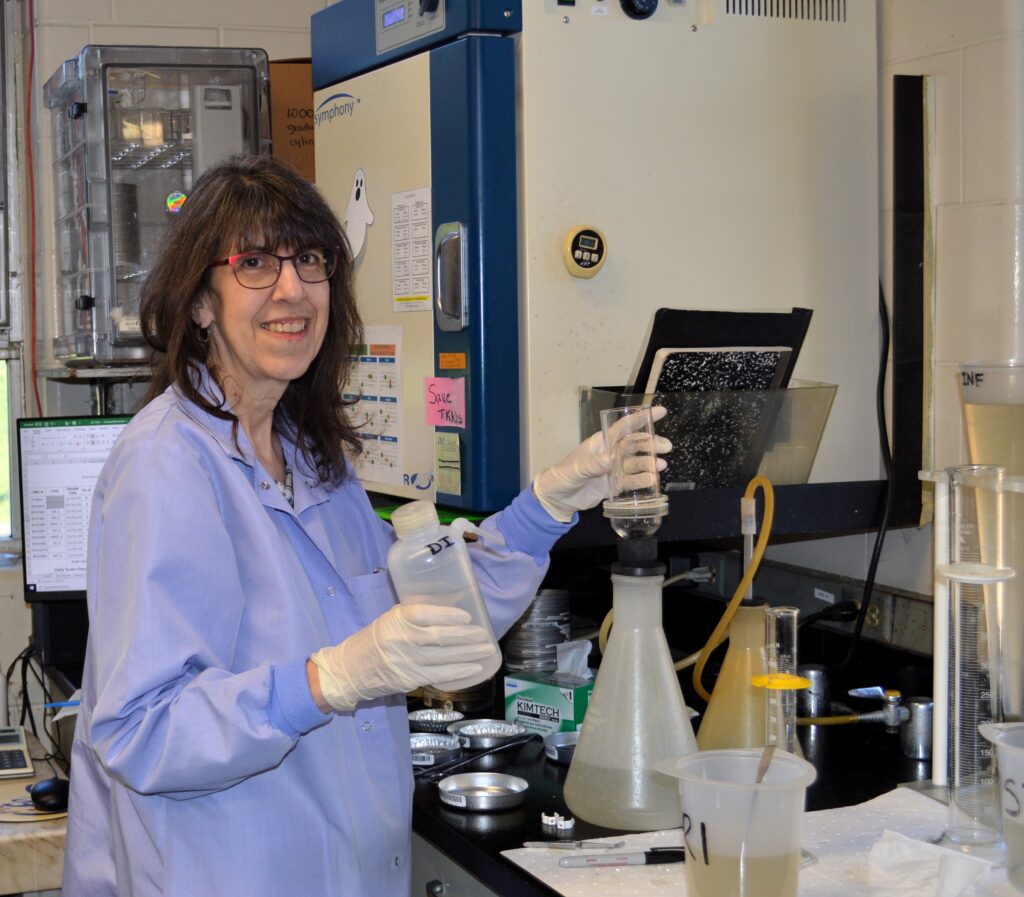
Laboratories Manager Gretchen Schleppy, a longtime LCA employee, handles laboratory operations, including oversight for staffing, regulatory reporting, instrumentation, troubleshooting, and support for our annual water quality reporting. She says five technicians rotate between our two labs.
“One lab serves the water filtration plant, and one serves the wastewater treatment plant. These two labs are accredited by PA DEP,” she says. “Our technicians typically have a Bachelor of Science degree in chemistry, biology, environmental science, microbiology, and laboratory experience. Our own employees collect all samples, but analysis is done with some support by contracted local labs.”
In the accompanying photo, LCA Lab Technician Renee Vogel, who’s worked with the water authority for 34 years, runs some tests on a water sample. Our labs collect approximately 5,000 samples from various sites annually; in Allentown, 100 samples are collected each month. We determine the number of samples based on the population served by our systems.
What Do We Look For?
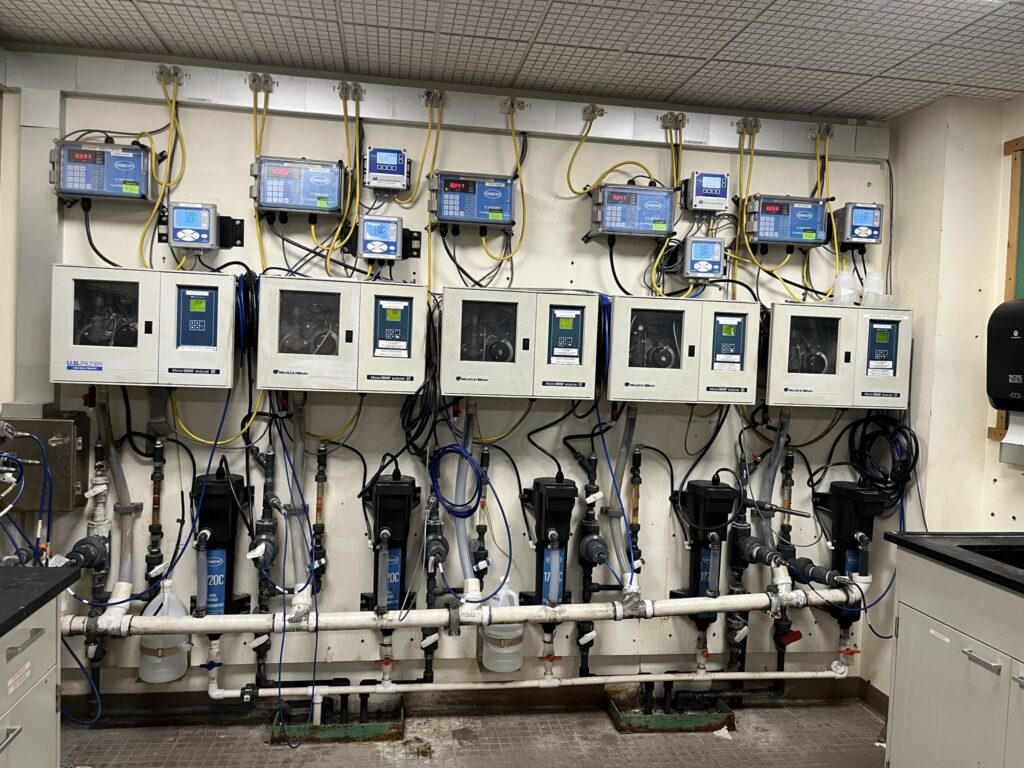
We perform a wide range of tests on our water for different conditions, substances, and parameters, including:
- chlorine
- inorganic compounds (substances such as nitrates and metals)
- total organic carbon
- alkalinity
- pH
- volatile organic compounds (carbon-containing compounds, not readily dissolved in water, usually found in gasoline, paint, dyes, degreasers, etc.)
- synthetic organic compounds (man-made compounds such as pesticides and PCBs)
In the accompanying photo, special process meters report test results.
LCA also conducts lead and copper sampling. “We are currently conducting a survey to help customers find out if they have a lead water service line,” Schleppy says. “In the survey, customers may opt-in to be part of our regulatory sampling for lead and copper. They’ll also learn information about how to reduce exposure to lead from drinking water.”
Wondering what’s in your water? You can find out on our interactive Your Drinking Water page, or check the drinking water quality report for your service area.
Award-Winning Service
We couldn’t be more proud of the team that brings you safe, reliable water service, and National Water Water Quality Month is the perfect time to celebrate their hard work. LCA has received numerous awards because of their commitment to clean water.
Those include a prestigious Area Wide Optimization Program (AWOP) Award; a 15-year Directors Award presented to our Water Filtration Plant by the Partnership for Safe Water for our team’s “commitment to superior water quality,” and recognition for our watershed stewardship and resource recovery work.
“The public has a tremendous role in protecting the water quality of our local drinking water sources. Polluting a waterway upstream at a park can flow downstream and impact the sources we pull drinking water from,” Schleppy says. “Everyone can take steps like cleaning up pet waste and properly disposing of wipes and expired or unused medications.”
Nine Ways to Make a Difference Today
Here are some simple, immediate steps you can take to conserve water:
- Wash your car at a car wash: It might cost more than washing your car at home. But taking your car to a car wash saves water and prevents toxic chemicals from being flushed down your storm drains. Some systems re-use the water. And professional car washes are required to drain into sewer systems so the water can be treated.
- Pick up after your pet: Animal waste contains harmful organisms, including E.coli, salmonella, and giardia. If you don’t pick up after your pet, the storm waters could wash these pollutants into our waterways. Animal waste is also high in nitrogen, which can cause algae blooms that, when they rot, kill fish and other aquatic organisms.
- Limit — or eliminate — the use of chemical fertilizers: After a heavy rainfall or watering, these chemicals can leach into nearby ground- and surface-water sources, causing nutrient pollution. Use organic materials, like compost, instead — or wait for drier weather.
- Do not flush expired or unwanted medication down the toilet: These products should never be flushed. Lehigh County has several collection options for safe disposal.
- Take used oil or antifreeze to a service station or recycling center. Don’t let these toxins run into a storm drain, where they will be washed into our rivers and streams. Promptly repair any vehicle leaks.
- Avoid antibacterial soaps or cleaning products unless directed by your health care provider. Not only are they toxic to marine life, studies have found they actually contribute to antibiotic-resistant bacteria.
- Dispose of chemicals such as paints, pesticides, and other hazardous wastes properly. Our local municipalities have regular collection events to help ensure these toxins don’t end up in our waterways.
- Use a Rain Barrel: Collect rainwater to use for watering your lawn and garden. You’ll even save on your water bill.
- Dispose of fishing line, hooks, packaging, and bait cups in the trash. Not only are these unsightly along the banks of our waterways, they harm wildlife and introduce microplastics into the water.